Presonus Eris E44 - Resigilat


Presonus Eris E44 - active 2-way studio monitor, with a frequency response of high accuracy. It is the smaller brother of the Presonus Eris E66 monitor. The MTM (Midwoofer-Tweeter-Midwoofer) configuration provides improved off-axis response and spatial resolution. It is equipped with a 1.25-inch silk dome tweeter, positioned between two 4.5-inch midrange drivers, which cover the same frequency range. The 2 drivers operate in parallel to minimize phase dispersion. The distance at which the two midrange drivers are positioned is so wide that their acoustic centre is smaller than the wavelength they reproduce, thus, the combined signal reproduced by the two drivers propagates as a single signal, behaving like a single larger driver. Due to this configuration, the monitor offers a very detailed stereo image, with dynamic output.


In a conventional 2-way monitor, the signals reproduced by the two components can interfere. The MTM configuration minimizes these interferences and provides the listener with a very wide sweet spot, and a listening experience on and off-axis that is much more consistent.

The midrange drivers are made of custom-woven Kevlar®, which provide a consistent dispersion pattern across the frequency range and deliver a transparent and coherent sound.

The usage position of this monitor is flexible, allowing it to be optimally used both horizontally and vertically.

Depending on the environment in which it is used, this monitor offers flexible acoustic calibration options, through the 3-position Acoustic Space switch, through the mid and high-frequency correction potentiometers, and through the 3-position low-pass filter, which allows the addition of a Tremblor subwoofer to the monitoring system.

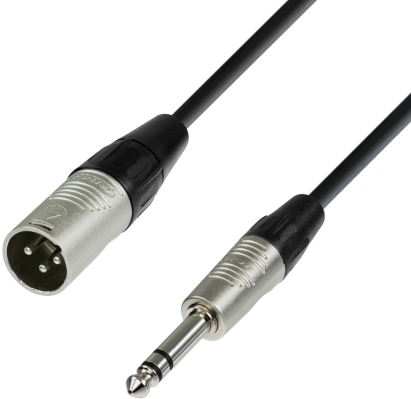
Connection options are also very flexible, through XLR connectors, balanced ¼” TRS, and unbalanced RCA.

Features:
- 4.5-inch custom-woven Kevlar® LF/midrange drivers, providing a dynamic response
- 1.25-inch silk-dome tweeter, offering a very precise high-frequency response
- XLR, balanced ¼” TRS, and unbalanced RCA connectors provide flexible integration in any environment and system configuration
- Acoustic calibration controls help compensate for room acoustic anomalies
- Controls for mid and high frequencies (-6 to +6 dB)
- 3 selectable low-pass filter settings (flat, 80 Hz, 100 Hz)
- 3-position Acoustic Space switch (Flat, -2 dB, -4 dB)
- Class A/B bi-amplification of 35/50W
- Protection against RF interference, output current limiting, over-temperature, and sub-sonic filter
- The amplifiers feature a “soft start” function, eliminating popping on startup
- Internal power supply with IEC connector
Technical Specifications:
- Inputs:
- 1x balanced XLR
- 1x balanced ¼” TRS
- 1x unbalanced RCA
- Frequency response: 55 Hz – 22 kHz
- Crossover frequency: 2.9 kHz
- Low-frequency amplifier: 50W
- High-frequency amplifier: 35W
- Peak SPL (at 1m): 103 dB
- LF drivers: Dual 4.5” Kevlar®
- HF driver: 1.25” silk dome
- Input impedance: 10 kΩ
- Mid-frequency control: Variable (-6 to +6 dB)
- High-frequency control: Variable (-6 to +6 dB)
- Low-pass filter: in 3 selectable settings (Flat, 80 Hz, 100 Hz)
- Acoustic space switch: in 3 selectable settings (Flat, -2 dB, -4 dB)
- Protections:
- RF interference
- Output current limiting
- Over-temperature
- Sub-sonic filter
- Turn-on/off transient
- External power supply fuse
- Power supply: 220-240V ~50/60 Hz
- Dimensions (W/D/H): 365/180/180 mm
- Weight: 5.4 kg
Product code: 2777506106
Unit of sale: piece
| Woofers: | 4.5" |
| Number of ways: | 2 |
| Tweeter type: | Dome |
| Correction type: | Analog |
| Power: | 70 W |
| Bluetooth connectivity: | no |
| Cabinet type: | Front port bass reflex |