Neumann MA 1



Neumann MA 1 - The automatic alignment of the MA 1 monitor from Neumann ensures the best possible sound quality in any room – from home studios to professional control rooms. Using the individually calibrated measurement microphone, your acoustic environment is analysed in a guided process. Advanced calibration algorithms, developed in collaboration with the world-leading audio processing institute, Fraunhofer IIS, guarantee an optimally adapted amplitude and phase correction for accurate and reliable monitoring.
General Features:
- Calibration algorithms developed in collaboration with Fraunhofer IIS
- For stereo configurations with KH 80 DSP and all pairs of Neumann analog monitors (without DSP) that use KH 750 DSP subwoofers
- Individually calibrated measurement microphone
- Adaptive room curve
- Phase and amplitude optimisation for Neumann analog monitors
- For Mac and PC
Reliable Monitoring Anywhere
The automatic alignment of Neumann is a dedicated tool for stereo monitor sets KH 80 DSP with or without KH 750 DSP, as well as two KH-Line monitors without DSP connected to the analog outputs of a KH 750 DSP subwoofer. Unlike conventional correction software, it is an integrated solution with new algorithms, developed in collaboration with the Fraunhofer Institute for Integrated Circuits (IIS) specifically for Neumann studio monitors. No special plug-in or audio driver is required: the alignment data is stored and processed in the DSP-powered monitors and subwoofer. As a unique benefit, the software not only optimises the amplitude response but also the phase. This provides the highest accuracy regarding tonality, impulse reproduction, and stereo localisation.
How It Works
In the first stage, the acoustic data of the listening environment is gathered in a guided process. No special acoustic knowledge is required. Simply connect your Neumann monitors to the outputs of your audio interface or monitor controller. Additionally, your DSP-based KH line monitors must also be connected to the ethernet port of your computer. For multiple connections, a standard Ethernet switch will be suitable.
Now connect the MA 1 measurement microphone to the microphone input. This microphone has been specially developed for this software and is individually calibrated by it. The software will guide you through the measurement process.
From the measured data, the software establishes the acoustic properties of the room. Individual correction parameters are generated according to a specific room curve calculated by the software. Decades of experience from Neumann in calibrating monitoring systems in studio control rooms have been incorporated into this process. Of course, you can modify the target curve according to your needs.
Different alignments, as well as complete hardware and measurement configurations, can be saved and conveniently recalled.
Additionally, the alignment process ensures an optimal summation of low frequencies when a subwoofer is used. This achieves a correct combination of timing and phase between monitors and subwoofer. The often perceptibly differentiated reproduction of the subwoofer and monitor is thus prevented. The result is a system as if cast from a single mould.
All resulting correction parameters are stored and processed in the DSP-powered monitors. So, there is nothing left for you to worry about, no plug-ins, no driver issues. And no additional cables: once the alignment process is completed, the ethernet connections are no longer necessary.
Possible Configurations
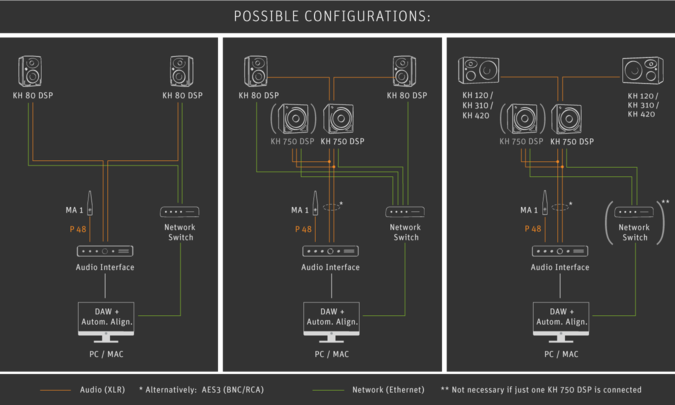
Using the KH 750 DSP subwoofer, the stereo sets of analog KH-Line monitors can also be used with the automatic monitor alignment software. The KH 750 DSP has enough processing power to align the entire system, including the two analog speakers connected to its outputs. Additionally, the KH 120, KH 310, and KH 420 speakers benefit from their built-in linear phase crossovers! The result is enhanced clarity, dry bass, and a correct timing representation and more precise reverberations and acoustic spaces.
The Future
The automatic alignment of the MA 1 monitor is the beginning of a new era in monitoring. Starting with the current version, which offers remarkable acoustic results for stereo settings, the range of software features will be gradually expanded with updates.
Hardware Requirements
- 1 pair of KH DSP speakers or up to two KH 750 DSP subwoofers in combination with a pair of analog KH speakers (non-DSP)
- Neumann MA 1 measurement microphone
- Computer (Windows 10 64-bit and macOS 10.13, 10.14, 10.15, or 11.0)
- Audio interface with balanced analog input with phantom power of 48 V and 2 balanced analog outputs or digital output AES3 (only with KH 750 DSP)
- Network switch
- Screen resolution of 1280×720 px or higher
Software Requirements
- Operating system: Windows 10 64-bit and macOS 10.13, 10.14, 10.15, or 11.0
- Neumann MA 1 – Automatic monitor alignment software
- ASIO driver (for Windows)
- IPv6 supported and enabled
DSP Loudspeakers (Activated in the Network)
The following speakers and subwoofers are activated in the network and can be controlled directly by the software:
- KH 80 DSP
- KH 750 DSP
Analog Loudspeakers (Inactive in the Network)
The following speakers are not activated for the network and must be connected via an activated subwoofer network to be included in the system configuration:
- KH 120 A
- KH 120 D
- KH 310 A
- KH 310 D
- KH 420/KH 420 + DIM 1
Important Information
Please note:
- After the alignment process, the MA 1 software stores the correction data in the monitors or subwoofer. Additionally, both the hardware configuration and the created alignment(s) are saved in the software and can be modified later if necessary. A continuous connection to the computer is only required if the speaker configuration needs to be controlled via the MA 1 during operation. This includes level settings, bass management (if a subwoofer is connected), and changes to configuration or alignment.
Therefore, no Ethernet connection to the computer is necessary for the subsequent operation of the aligned system. Currently, the data stored in the speaker(s) cannot be recalled or modified once the software is closed. The calibration procedure must be started from the beginning and repeated.
- Currently, the following applies: If the speakers have been previously tuned using the Neumann.Control iPad® application, their correction data will be overwritten by an alignment with the MA 1 software. If you reopen the Neumann.Control iPad® application, the last data stored in the application is sent to the speakers, thus overwriting the correction data generated by the MA 1.
- The alignment settings are made via the MA 1 software. Other parameters (e.g.: mute, delay, etc.) cannot currently be controlled by the MA 1 software.
- The MA 1 software does not include guided alignment or manual alignment, as in the Neumann.Control iPad® application.
Technical Specifications:
| Acoustic operating principle | Pressure transducer |
| Directional Model | Omnidirectional |
| Frequency range | 20 Hz - 20,000 Hz |
| Sensitivity: 1 kHz at 1 kohm | 30 mV/Pa -30 dBV +/- 3 dB uncalibrated | 30 mV/Pa -30 dBV +/- 0.5 dB Calibrated (via software) |
| Nominal impedance | 50 Ohms |
| Nominal load impedance | 1000 Ohms |
| Equivalent noise level, CCIR1 | 39 dB |
| Equivalent noise level, A-weighted2 | 27 dB-A |
| Max SPL for THD 0.5%3 | 132 dB |
| Signal-to-noise ratio, CCIR (ref. 94 dB SPL)4 | 55 dB |
| Signal-to-noise ratio, A-weighted (ref. 94 dB SPL)5 | 67 dB |
| Max output voltage | 10 dBu |
| Power supply (P48, IEC 61938) | 48 V ± 4 V |
| Current consumption (P48, IEC 61938) | 3 mA |
| Suitable connector | XLR3F |
| Weight | 37 g |
| Diameter | 23 mm |
| Length | 117 mm |
| Operating conditions | 0 °C - +70 °C; max. 90 % at +20 °C |
| Transport/storage conditions | −20 °C - +70 °C; max. 90 % at +20 °C |
1) according to IEC 60268-1; CCIR weighting according to CCIR 468-3, quasi-peak; A weighting according to IEC 61672-1, RMS
2) according to IEC 60268-1; CCIR weighting according to CCIR 468-3, quasi-peak; A weighting according to IEC 61672-1, RMS
3) measured as equivalent electrical input signal
4) according to IEC 60268-1; CCIR weighting according to CCIR 468-3, quasi-peak; A weighting according to IEC 61672-1, RMS
5) according to IEC 60268-1; CCIR weighting according to CCIR 468-3, quasi-peak; A weighting according to IEC 61672-1, RMS
Diagrams
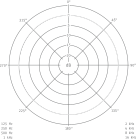
Omni MA 1
Microphone Linearization
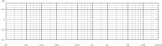
To utilise the full potential of your MA 1 microphone in third-party measurement applications, the individual correction curve can be calculated here. The individual correction parameters can then be downloaded as a simple text file for import into third-party software.
- The calibration curve that follows is to be ADDED to the measured data
- The calibration curve is valid for an incidence angle of 90° (i.e., the microphone pointing vertically)
Product code: 508972
Unit of sale: piece