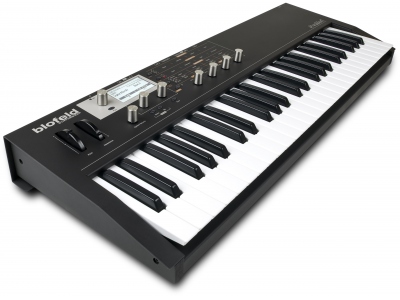
Waldorf Blofeld Keyboard is a virtual-analog synthesizer with a semi-weighted keyboard featuring 49 keys, velocity and aftertouch. The Blofeld keyboard is the successor to the well-known Blofeld, which has grown not only in weight and size but also in its capabilities: in addition to the classic virtual-analog and wavetable synthesizer, it now includes 60MB of samples. It features a metal casing as well as a large display and internal power supply.
synthesizer with semi-weighted keyboard and 49 keys, velocity and aftertouch
internal power supply (100-240V, 50-60Hz)
pitch bend wheel
modulation wheel
sustain pedal connector
Octave Up / Down
flexible programming
polyphony of up to 25 voices
over 1000 sounds
durable metal casing
steel potentiometers
8 buttons
graphic display 128 x 64 pixels and white LED backlighting
MIDI LED
volume control
power switch
stereo output
headphone output
MIDI input/output
USB interface for MIDI
minimum Windows ME, recommended Windows XP or newer
minimum Mac OS X 10.2, recommended Mac OS X 10.3 or newer
approx. weight 8 kg
60 MB sampler memory
Virtual analog, Wavetable and sample-based oscillators
3 oscillators / voice
frequency modulation between oscillators
Microwave II/XT/XTk Wavetable
2 independent multi-mode filters per voice
FM filter
3 LFOs per voice
4 Envelopes per voice
arpeggiator with programmable rhythms (16 steps)
Interface
Preset Selection
Seven infinitely rotatable buttons made of steel provide in-depth exploration of the power of the Blofeld. Browsing through the preset sounds is done by turning the knob above the play button. Changing the bank used is done via the left button below the screen. The button to the right filters the sounds traversed by their category.
Editing
The most frequently used parameters are arranged on the front panel. Select the button on the left of the proposed parameter row and use the 4 rotary buttons to directly modify the parameter in the matrix. This matrix allows direct control over: the waveforms of the oscillators, semitone shift, fine tuning and levels (filter cutoff, resonance, filter type and amplitude of the winding), parameters from two of the four windings, frequency and waveform of the LFO (two out of three total), modulation matrix, effects mixing, operating mode and arpeggiator measure.
When the rotary button is pressed, the screen changes to the detailed editing page of the corresponding section.
Oscillators
Selecting one of the oscillators displays the corresponding oscillator type page on the screen. Each oscillator, the ring modulator and the noise generator can be freely mixed into the input of the two independent multi-mode filters. A special overview page shows the routing, level and waveforms of the generators.
Filters
Of course, the two filters have dedicated pages for displaying the response curves. Here you see an example of the 24dB low-pass filter. Even the notch filter is displayed graphically. The two filters can be routed in series or parallel, the latter mode allowing independent panning of the two filters.
Envelopes and LFOs
The envelopes can be classic, ADSR, looped or without the Hold and Release stages (one-shot). However, we have 5 types of envelopes. The three low-frequency oscillators (LFO) provide separate parameters for delay and fade in/out. Here we have an example.
Modulations
What can we do with all these envelopes, LFOs and other control sources? Instead of using them as direct modulation sources, we can easily connect them to other modulation destinations in the matrix.
And if all this is not enough: we can create new modulation sources by modifying an existing one through algorithmic operations. Sounds complicated? Maybe. But it’s fun even if you don’t understand what you’re doing. The modifier in the image creates a gradual modulation based on the continuous waveform of LFO1, whatever the waveform may be.
Arpeggiators
Last but not least, let’s not forget one of the most fascinating arpeggiators found in VA synths, first introduced in the Waldorf Q. In addition to standard features (measure division selection, shuffle variation setting, range of up to 10 octaves, directions), different note lengths with different accents can also be set. But it opens up the full range of possibilities through the added step sequencer for editing arpeggiator patterns.
Spectre
Spectre is a tool for creating and transferring samples to the Waldorf Blofeld with the License SL extension and Waldorf Blofeld Keyboard. This application is compatible with Windows and Mac and is available for free to anyone from the official Waldorf website.


 Seven infinitely rotatable buttons made of steel provide in-depth exploration of the power of the Blofeld. Browsing through the preset sounds is done by turning the knob above the play button. Changing the bank used is done via the left button below the screen. The button to the right filters the sounds traversed by their category.
 Selecting one of the oscillators displays the corresponding oscillator type page on the screen. Each oscillator, the ring modulator and the noise generator can be freely mixed into the input of the two independent multi-mode filters.
  A special overview page shows the routing, level and waveforms of the generators.
 Of course, the two filters have dedicated pages for displaying the response curves. Here you see an example of the 24dB low-pass filter.
 The two filters can be routed in series or parallel, the latter mode allowing independent panning of the two filters.
 The envelopes can be classic, ADSR, looped or without the Hold and Release stages (one-shot). However, we have 5 types of envelopes.
  The three low-frequency oscillators (LFO) provide separate parameters for delay and fade in/out. Here we have an example.
 What can we do with all these envelopes, LFOs and other control sources? Instead of using them as direct modulation sources, we can easily connect them to other modulation destinations in the matrix.
 The modifier in the image creates a gradual modulation based on the continuous waveform of LFO1, whatever the waveform may be.
 Last but not least, let’s not forget one of the most fascinating arpeggiators found in VA synths, first introduced in the Waldorf Q. In addition to standard features (measure division selection, shuffle variation setting, range of up to 10 octaves, directions), different note lengths with different accents can also be set. But it opens up the full range of possibilities through the added step sequencer for editing arpeggiator patterns.
 Spectre is a tool for creating and transferring samples to the Waldorf Blofeld with the License SL extension and Waldorf Blofeld Keyboard. This application is compatible with Windows and Mac and is available for free to anyone from the official Waldorf website.