Focusrite Pro ISA One Analogue


Focusrite ISA One Analogue, preamplifier from the ISA series in a portable format. Featuring the classic preamplifier topology from the Focusrite ISA 110 model, the ISA One includes Lundahl L1538 transformers and a Zobel network, which was one of the main advantages of the Focusrite Forte consoles.
ISA One is ideal for both engineers and performing artists, offering independent gain control, an output for connection to an amplifier, an independent XLR output on the rear panel, and routing to the optional A/D converter.
It features an input impedance selector with four carefully chosen impedance settings for perfect interfacing with any microphone. An insert point positioned between the preamp/DI level and the optional A/D converter allows the insertion of an external effect. The unit can be upgraded with an optional analogue-to-digital conversion card (up to 192kHz) with a dynamic range of 118dB. However, there is also an ISA One version already equipped with this card.
Specifications
- Microphone input:
- gain range: 0-60dB in 10dB steps
- selectable input impedances: 600Ohm ("Low"), 1400Ohm ("ISA110"), 2400Ohm ("Med"), 6800Ohm ("High")
- EINL -126dB measured at 60dB gain with a 150Ohm terminal impedance and a band-pass filter set at 22Hz-22kHz
- SNR relative to maximum headroom (9dBu): 106dB
- THD at medium gain (30dB): 0.0009% measured with a 1kHz - 20dBu signal and a 22Hz-22kHz band-pass filter
- Frequency response at minimum gain (0dB): -0.5dB at 10Hz and -3dB at 125kHz
- Frequency response at maximum gain (60dB): -3dB at 16Hz and -3dB at 118kHz
- crosstalk: with 10dB@1kHz on channel A, output on channel B: 104dBrA. With 10dB@10kHz input on channel A, output on channel B: 84dBrA.
- Line input
- gain range: -20dB to +10dB in 10dB steps
- input impedance: 10kOhm from 10Hz to 200kHz
- noise at main output at 0dB gain: -96dBu measured with a 22Hz-22kHz band-pass filter
- SNR relative to maximum headroom (24dBu): 120dB
- SNR relative to 0dBFS (+22dBu): 118dB
- THD at 0dB gain: 0.001% measured with a 0dBu input signal and a 22Hz-22kHz band-pass filter
- frequency response at unity gain (0dB): below -0.3dB at 10Hz and below -3dB at 200kHz
- Instrument input
- gain range: 10dB-40dB adjustable continuously
- input impedance: "High" >1MOhm and "Low" >300kOhm
- noise at minimum gain (+10dB): -92dBu measured with a 22Hz-22kHz band-pass filter
- noise at maximum gain (+40dB): -62dBu measured with a 22Hz-22kHz band-pass filter
- THD at minimum gain (+10dB): 0.001% measured with a 10dBu input signal and a 22Hz-22kHz band-pass filter
- frequency response at 10dB gain with a -10dB input signal: 10Hz-100kHz +/-0.6dB
- frequency response at 40dB gain with a -40dB input signal: -2.5dB at 10Hz and 0dB at 100kHz
- High-pass filter
- 18dB per octave attenuation
- Display
- calibratable VU
- signal level LEDs
- Connections
- analogue channel inputs
- microphone input: 1 x XLR
- line input: 1 x XLR, 1 x TRS
- instrument input on TRS
- input for external AD converter: 1 x TRS
- return on TRS
- analogue channel outputs
- Send on TRS
- balanced output on XLR
- DI output on XLR
- DI thru: TS jack
- additional: cue mix left and cue mix right TRS, headphone output on 1/4" TRS
- Dimensions: 220 x 104 x 254-290mm, 3.9kg
Diagram 1 - vocal recording with ISA One
In a setup similar to the following, the vocal can be sent to the mixer, where it is mixed with the backing track and sent back to the ISA One via the cue mix input.

Diagram 2 - guitar recording with backing track in headphones
With the cue mix switch inactive, the headphone mix is a blend of the two inputs. In this case, the inputs are guitar (INST) and mono signal (EXT IP) from the DAW. This allows a zero-latency mix between the guitar and the backing track through headphones.
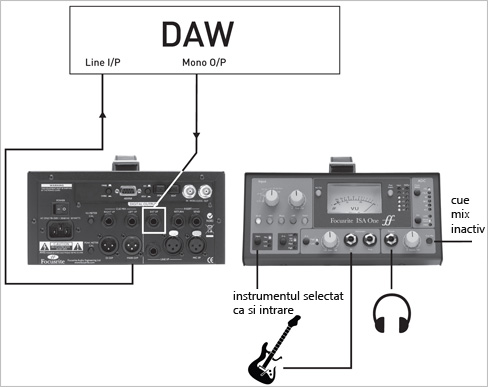
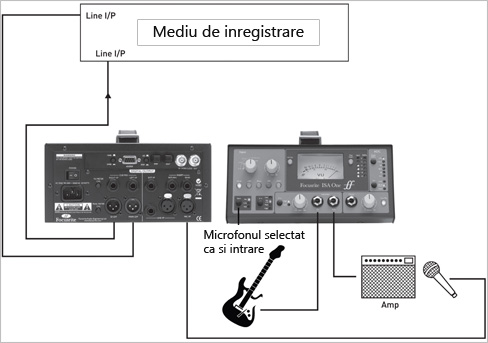
Diagram 3 - guitar recording on two inputs
In this case, if you want to record digital signals, the stereo output from the optional digital card (if installed) will present exactly the MAIN and DI outputs (left and right, respectively).
If recording through a mixing console or other low-latency environment, the stereo mix with the backing track and guitar can be sent back to the CUE MIX input (left and right) of the ISA One. This way, the guitarist will have a zero-latency headphone mix (as in diagram 1).
If recording with a DAW, the backing track can be sent in mono to the ISA One via EXT IP (as in diagram 2). However, in this case, the second channel of the stereo output from the digital card will be the EXT IP signal and not DI IP, meaning the microphone and guitar signals must be recorded through the analogue connections as shown in the diagram below.
Product code: MOIFONEA-EU
Similar products in stock